Friday, August 5, 2016

Scandal-rocked Malaysia might soon be a hot investment

Malaysia is home to the world’s longest running bull market. That doesn’t mean it’s been a great place to invest – although it might be soon.

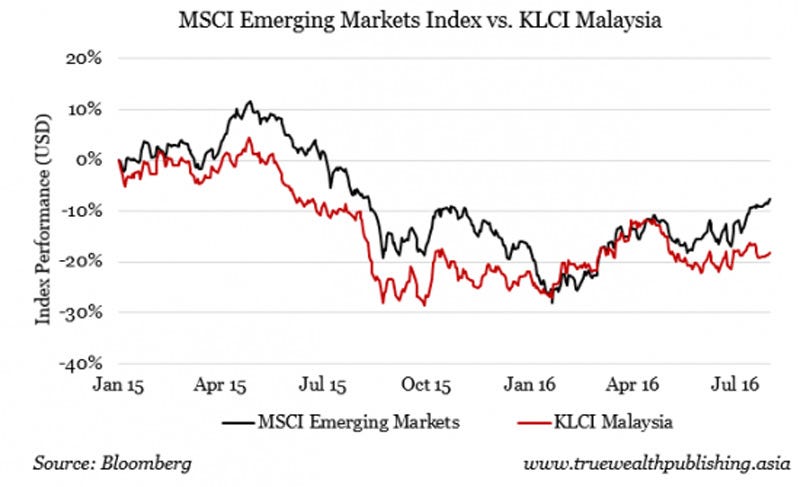
The MSCI Emerging Markets Index, which covers 23 emerging markets, is up 11 percent year-to-date and 6 percent over the last three months (in U.S. dollar terms). The Kuala Lumpur Composite Index (KLCI) hasn’t kept up – it’s up 5 percent so far this year and down 4 percent over the past three months.

Malaysian shares’ relative weakness isn’t new. Since the beginning of last year (as shown below), emerging markets are down 8 percent, but Malaysian shares are down 18 percent (both in U.S. dollar terms).
Truewealth Publishing

Usually, Malaysian stocks move in unison with other emerging markets. This is because factors that affect the Malaysian market are the same factors that drive global emerging markets – like commodity prices, the strength of the U.S. dollar and investor sentiment towards emerging markets. But that hasn’t been the case over the past eighteen months.
The scandal

The beginning of Malaysia’s stock market underperformance can be traced to late 2014 when the “1MDB” scandal came to light. The scandal involves the US$11 billion government investment fund 1 Malaysia Development Berhad (1MDB). The fund was set up by Malaysian Prime Minister Najib Razak in 2009 to invest in the Malaysian economy. But it has also allegedly been used to line the pockets of the prime minister and his associates.

Over US$3.5 billion was allegedly misappropriated from 1MDB. Investigations are ongoing in at least six countries around the world. A cross-border investigation by Singapore into 1MDB is reported to be the largest money laundering probe Singapore has ever undertaken.

A few weeks ago, the U.S. Department of Justice (DOJ) announced it is attempting to seize US$1 billion in assets allegedly purchased with funds misappropriated from 1MDB. The DOJ alleges that stolen money from 1MDB found its way to numerous associates of the prime minister, who allegedly went on a lavish worldwide spending spree from 2009 through 2013.

(Some of the funds were allegedly used to help produce the 2013 film “The Wolf of Wall Street.” Ironically, the film, about a corrupt stockbroker, was produced by a company that was co-founded by Najib’s stepson – and was banned in Malaysia for being too risqué.)

The U.S. has not explicitly named the prime minister as complicit in the embezzlement, though documents mention “a high-ranking official’s” involvement. Najib has strongly denied any connection to wrongdoing and has fought the investigations.
Malaysian versus Brazilian markets

Weakness in oil prices – critical to Malaysia’s economy – has hurt sentiment towards Malaysian shares over the past year and a half. The country’s currency, the ringgit, fell 18 percent against the U.S. dollar last year. And the 1MDB scandal has also played a big role in keeping investors away.

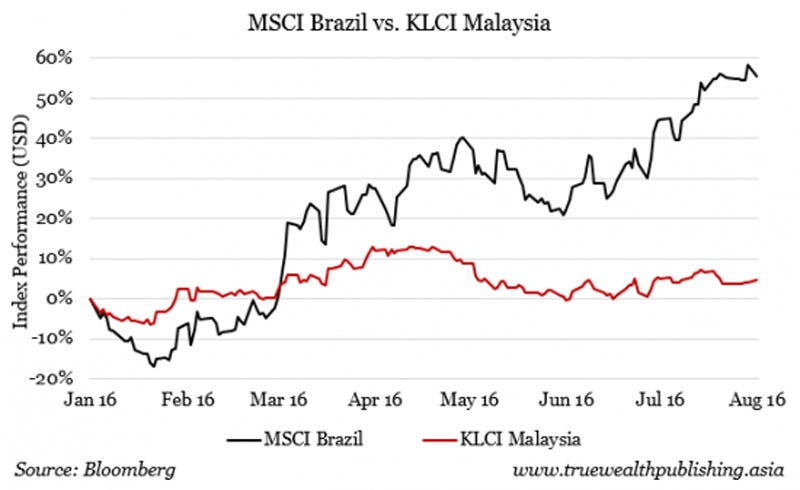
Brazil is another oil-dependent emerging market that’s suffered through a long-running government corruption scandal. But its stock market, one of the best-performing emerging markets of the year so far, has rallied by 87 percent in U.S. dollar terms from its January low.
Truewealth Publishing

A key difference between Malaysia and Brazil is that Brazil launched aggressive investigations of implicated officials when the scandal broke. This has created the impression that the worst of the scandal is past. Not coincidentally, the January arrest of the country’s president marked Brazil’s market lows.

In contrast, Malaysia’s government is still officially denying that anything is amiss. The prime minister has dug in his heels, and has tried to thwart the investigation into 1MDB. Markets hate uncertainty, and until the scandal is under control, Malaysia’s stock market will continue to lag.

Malaysia’s market won’t stay down for long

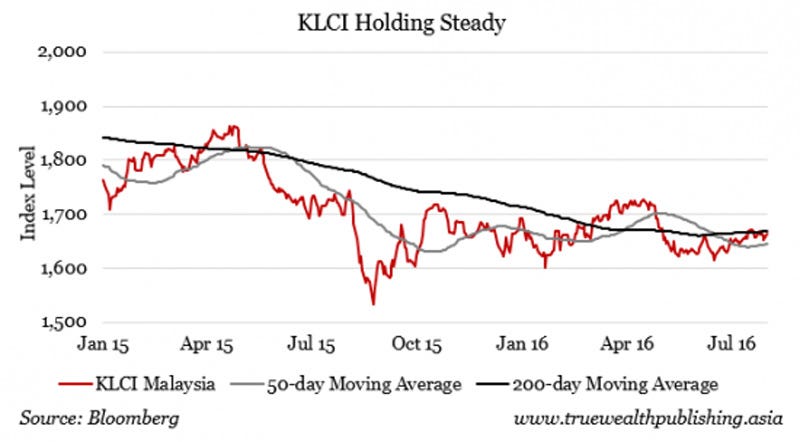
But note that while Malaysia has lagged the July emerging markets rally, its stock market hasn’t fallen much. It is holding above its 200-day and 50-day moving averages, so it remains in an uptrend. This suggests that there is strong support for Malaysian shares – as we’ve mentioned before – including big Malaysian institutional funds.
Truewealth Publishing

Malaysian stocks will likely start climbing before the 1MDB scandal is resolved, similar to the way that Brazilian shares started to recover when the scandal peaked.

This is because stock markets are forward-looking. They anticipate how future events will affect stock valuations. So at some point – it could have already happened – the worst case outcome from the 1MDB affair will be reflected in Malaysian share prices. The market will start performing better despite negative headlines.

Going forward, as more 1MDB revelations emerge, investors should note how the index reacts to additional bad news. If the price doesn’t go down or rallies, it could mean Malaysian stocks are still attracting investors. These investors may be buying in anticipation of a return to normalcy. That could be when Malaysian shares switch from emerging market laggards to leaders.

To invest in Malaysia if and when things change, start looking into these ETFs: the db X-trackers MSCI Malaysia Index ETF (Singapore; code LG6); the XIE Shares Malaysia ETF (Hong Kong; code: 3029) which tracks the FTSE Bursa Malaysia KLCI Index; the iShares MSCI Malaysia ETF (New York Stock Exchange; ticker: EWM).

Source : http://www.businessinsider.com/scandal-rocked-malaysia-might-soon-be-a-hot-investment-2016-8?IR=T&r=US&IR=T

Tuesday, August 2, 2016

DRBHCOM News Update

1. Honda's first-quarter operating income was its best since the 2008 financial crisis


2. DRBHCOM hold 34% Honda Malaysia Sdn Bhd. (latest annual report 2016)

3. DRBHCOM hold 32.21% POS Malaysia Berhad. (latest annual report 2016)

4. Net profit from Honda Malaysia Sdn Bhd - RM578.476 million. Net profit from POS Malaysia Berhad - RM63.093 million

5. DRB-HICOM Auto Solutions Sdn Bhd (DHAS) DHAS provides end-to-end logistics solutions for the automotive industry, from the import of completely built up (CBU) vehicles and completely knocked down (CKD) kits to the final delivery of vehicles to the dealer network. DHAS also conducts pre-delivery inspection (PDI) for nine imported vehicle makes, namely Audi, BRP, Honda, Isuzu, Jeep, Mitsubishi, Suzuki, Tata and Volkswagen. In addition, DHAS also provides accessory installation services for both CBU and CKD cars at its PDI centres in Pekan, Pahang and in Shah Alam, Selangor.

6. Honda Malaysia Sdn Bhd (Honda Malaysia) During FY2015/2016, Honda Malaysia achieved No.1 position in the non-national segment, exceeding the budgeted 92,000 units. Honda Malaysia also launched a new variant to its new CR-V and introduced a new generation of compact SUV named HRV during the year. This drove sales up to an increase of 14.8% with 95,403 units sold compared to 83,106 units last year. Sales revenue for the year also increased by RM1.3 billion, up by 20.9% from FY2014/2015 with the Honda City as the major contributor followed by the newly launched HRV with 38.3% and 25.9% of the total units sold respectively.

7. POS Malaysia Berhad giving out 11.5 sen dividend ( Ex-date 07/09/2016) meaning

537.026 million shares x 32.21% x RM0.115 = RM20.5 million dividend pay out to DRBHCOM

以上纯属个人分析与评论,如有任何疑问,欢迎与我交流讨论。任何股票买卖建议输赢绝对不负责。
From:林友志 (Lim Yu Chee)

July ETF


An ETF, or exchange traded fund, is a marketable security that tracks an index, a commodity, bonds, or a basket of assets like an index fund. Unlike mutual funds, an ETF trades like a common stock on a stock exchange. ETFs experience price changes throughout the day as they are bought and sold. 

ETFs typically have higher daily liquidity and lower fees than mutual fund shares, making them an attractive alternative for individual investors.

Because it trades like a stock, an ETF does not have its net asset value (NAV) calculated once at the end of every day like a mutual fund does.


Monday, August 1, 2016

Why Average Investors Do Not Make Money

The average investor makes poor returns on his money. In 2015, Dalbar's Quantitative Analysis of Investor Behavior (QAIB) reported that the average 30-year annualized return for investors in blended mutual funds was 1.65%. Fixed-income fund investors fared even worse, returning 0.59% annually. Meanwhile, the Standard & Poor's (S&P) 500 Index advanced by 10.35% per year over the same period, while the Barclays Aggregate Bond Index returned 6.73% annually.

Investors have themselves to blame when assigning fault for underperforming the market so severely. Several decision-making errors prevent average investors from fulfilling their potential. Investors fail to make appropriate buy and sell decisions based on time horizon. They avoid profit-taking on winners and fail to cut losers with poor long-term outlooks. They chase popular stocks instead of following Warren Buffett's advice and seeking out ones the market undervalues. Lastly, average investors take risks not commensurate with potential rewards.

Time Horizon

A smart investor knows his time horizon and makes buy and sell decisions accordingly. With a 20-year time horizon, the best time to purchase new shares is when the price drops. Even if it falls further, the investor has years to recover from losses. Strategies such as dollar-cost averaging work well with lengthy time horizons, as it ensures more shares are purchased when the price is low and less are bought when the price is high.

An investor with a short time horizon, such as 24 hours to a week, should be more reticent about buying on dips. If the stock takes too long to recover, the investor does not make his money back. Unfortunately, the average investor often follows the opposite of this protocol. He puts more money in long-term investments when they are hot and loads up on short-term investments on dips.

Profit-Taking and Loss Mitigation

A tenet of buy-and-hold investing is resisting the urge to cash in after a gain or dump a security at the first sign of trouble. That said, the best investors are in tune with their portfolios and recognize when a stock is overheated or, conversely, when a struggling security has little chance of recovering. In these situations, savvy investors do not hesitate to take some profit on the winner or sell shares of the loser to mitigate losses.

The average investor lets the winner ride and holds on to the loser in hope of cashing in on a recovery, consequently leaving a lot of money on the table.

Chasing Popular Stocks

Chasing popular investments usually results in overpaying. Dotcom investors in early 2000 and real estate investors in 2005 learned this the hard way. Just because something is currently hot does not make it a good long-term investment. Warren Buffett amassed his fortune by investing in stocks the rest of the market was ignoring. In other words, he went against what was currently popular. The average investor follows herd behavior, buying shares that are overvalued.

Understanding Risk and Reward

Risk and reward go hand in hand. However, average investors take unnecessary risks not justified by potential rewards. For example, holding an overnight position in day trading represents a risky proposition. Too much could happen between the closing and opening bells, such as a major news event.

An investor who does not understand risk and reward holds on to a high-performing stock even with industry news emerging that portends trouble. While average investors fail to balance risk and reward appropriately, smart investors employ cost-benefit analysis to determine when it is suitable to take a risk.

Applying This Knowledge to XOP Investors

The SPDR S&P Oil & Gas Exploration & Production ETF (NYSEARCA: XOP) experienced high volatility from 2014 to 2016. Its caprice has made savvy investors lots of money and lost mediocre investors equally large sums. It traded as high as $80 per share in July 2014 before falling to $22 per share in February 2016. It has since embarked on a slow but steady climb and, as of July 2016, traded at $34 per share.

Consider how a savvy investor versus an average investor might have applied the four tenets above to this ETF. Recognizing the unlikeliness of oil prices staying depressed forever and understanding that the ETF is effectively on sale, a savvy investor with a lengthy time horizon would have loaded up on it in February 2016. Meanwhile, the average investor would have sold out of fear and missed the incipient rebound.

Smart investors with shorter timelines recognized the need to cut losses when oil went into a tailspin in late 2014. Less-skilled investors could not bear to sell at a loss and held on longer than they should have while hoping for a recovery.

When seemingly everyone was bearish on oil, average investors avoided this ETF because of its unpopularity. On the other hand, savvy investors went against the crowd to buy it and enjoyed a 54% gain from February to July 2016.

Smart investors took the right amount of risk with regard to such a volatile ETF. Average investors either avoided it altogether or purchased too many shares at the wrong time.

Tuesday, July 26, 2016

Timeline : KL-SIngapore High-Speed Rail


Market Review 股市回顾


1。短期-吉隆坡综合指数还是没有办法强力突破200天平均线。支持点落在1643,1611。 阻力点 1676,1697。强力支持点是1600点(这个关键点不能跌破,跌破的话整个大环境就不好了),如果期望马股有牛市的话1690必须冲破才会有望。


2。如果以月图线来看的话指数在三月和四月经历了大跌幅,五六月开始微反弹,继续反弹的机率可能比较大不过力道应该不强.

3.从经济角度来看马来西亚的经济算是差的,2016年GDP成长预测放缓到了4%, 国家银行也第一次被迫选息来刺激经济。虽然英国在6月的公投决定脱离欧盟后造成许多热钱从欧洲转移到亚洲找寻找避风港。但是这次这一波热钱只买进马来西亚的债券股票买的特别少,其他国家如韩国,台湾,新加坡,印尼,泰国等国家股市和债市短期都强力反弹。马来西亚的政治不稳定性看来继续影响马股起不了。


4。新加坡海峡指数在经历过了BREXIT (23/06) 后开始强力反弹超越了200天移动平均线。


5。香港恒生指数的波动也一样,在经历了BREXIT 后开始强力反弹。


6。美国道琼斯工商指数还是保持在最高点, 许多人预测美国会在八月份大跌且让我们拭目以待。美国为什么会起?这主要还是因为美国的经济持续复苏以及失业率低。预计美国或许会在微调整过后持续往上,这种可能性也不是不可能。


7。S&P 500 也是一样站在最高点。接下来的几天我们会迎来几间重量级的公司要报业绩。 Apple 26/07, Facebook 27/07, Google 28/07 以及 Amazon 28/07.


8。我们认为油价一直以来人为的操控都很大,可是终有一天还是会回归基本面。美国的库存量是人在点算的所以很容易被人被拿来乱作文章。但是这一次油价开始不断滑落主要真的是因为全球的库存量太多了,不论是海上还是陆地上。

可以参考 : http://wallstreetcn.com/node/255240


9。在这动荡的年代黄金绝对是投资者的最爱, USD1300支持点如果有跌破的话是机会买进。一些分析师已经把黄金目标价长期放在USD1800了。

10。现在的马股很难投资就连投机的机会都很少而且很多股来得快去的也快。不过机会还是有的,所以这一次我们决定不时在这里的讨论区以及comment 里介绍一些股票因为这样比较快。希望大家可以一起勇于讨论以及分享一些意见。谢谢!

以上纯属个人分析与评论,如有任何疑问,欢迎与我交流讨论。任何股票买卖建议输赢绝对不负责。
From:林友志 (Lim Yu Chee)

Sunday, June 19, 2016

Deutsche Bank AG 德意志银行

德银:下一个“雷曼兄弟”?


Current Price USD15.62 Chance?机会买进??

以上纯属个人分析与评论,如有任何疑问,欢迎与我交流讨论。任何股票买卖建议输赢绝对不负责。
From:林友志 (Lim Yu Chee)

Wednesday, June 15, 2016

最新指数更新


1.吉隆坡综合指数看下,跌破了200天平均线也跌破20天平均线,支持点1614然后1595.如果1595都跌破的话继续下跌的机率很大.


2.新加坡和香港的指数也都不好.BREXIT - 英国公投是否要脱离欧盟对各国的影响都很大,大家选择套利或逃离股市买进国家债券. 现金是王道,等待机会的来临.


3.美国指数连跌五天不过还能保持在200天的平均线上.

4.喜欢这句话与大家共勉之.

"有勇气,智慧,闲钱的人才能从危机看到机会. 
  勇气,智慧,闲钱,三个条件缺一不可"

以上纯属个人分析与评论,如有任何疑问,欢迎与我交流讨论。任何股票买卖建议输赢绝对不负责。
From:林友志 (Lim Yu Chee)

Monday, June 13, 2016

人民日报:中国不可能落入中等收入陷阱

作者刘世锦 为国务院发展研究中心原副主任

我国经济发展进入新常态,经济结构和增长动力发生重要转变,增长速度由高速转为中高速。于是,关于中国经济是否会硬着陆、落入“中等收入陷阱”的议论多了起来。这个问题应放在长期增长框架下并在国际比较中加以分析。

中国已不可能落入拉美式“中等收入陷阱”

二战以后,先后有许多经济体进入工业化历史进程,但只有少数经济体跨过中等收入阶段进入高收入社会。从中可以观察到两种不同类型的经济增长速度回落。

一种是经历了一段时间的高速增长,在人均国民总收入不超过六七千国际元(购买力平价指标)时增长速度回落,陷入增长缓慢、停滞乃至倒退的困境。这些经济体大多实施进口替代战略,抑制市场力量的发展,借用大量外债,出现了严重的两极分化。有的迫于民粹主义的压力,实行难以承受的高福利政策,最终导致高增长难以为继。典型代表是部分拉美国家。

另一种是经历了一个更长时期(通常是二三十年以上)的高速增长,在人均国民总收入达到11000国际元时增长速度出现回落,由高速增长转为中速增长,并跻身于高收入行列,其典型是日本、韩国、中国台湾省和香港特别行政区、新加坡等东亚经济体。这些经济体具有较好的市场基础,同时也有发展导向的强政府,实施出口导向战略,形成了具备较强国际竞争力的产业。

我国改革开放以来经历了30多年的高速增长,近年来增长速度有所放缓。2014年我国人均国民总收入大体上相当于11000国际元,增长模式和轨迹与东亚经济体显示的增长规律较为相似。从长期增长框架看,我国已经成功利用了工业化时期高速增长的潜力;当前经济增长条件出现一系列重要变化,构成经济发展的新困难,经济合乎规律地由高速增长转为中高速增长。应该认识到,我国现在达到的发展水平远高于当年拉美国家落入“中等收入陷阱”时的发展水平,已经不可能落入拉美式“中等收入陷阱”。只要经济能够实现由数量追赶向质量追赶的平稳转型,就能够成功跨越中等收入阶段,进入高收入社会。

中国经济正在进入更具创造性和可持续性的中高速增长平台

中国经济由高速增长转为中高速增长,是一个“转型再平衡”的过程。从需求侧看,以往长时期带动高增长的低成本出口、大规模开发建设、排浪式消费等主要需求发生深刻变化和调整。在供给侧,由于重化工业调整相对较慢,部分行业出现了严重的产能过剩,企业亏损扩大。但从今年一季度情况看,在供给侧结构性改革的作用下,部分工业品价格有所回升,工业企业效益由降转升。如果去产能到位,工业品出厂价格和工业企业利润增速回升,供给侧也有望调整到位。随着供需两侧达到新的平衡,我国经济将进一步释放增长潜力,进入更具创造性和可持续性的中高速增长平台。

中高速增长期依然是追赶期。目前我国人均国民总收入约为8000美元,与发达国家人均四五万美元相比仍有较大差距。如果说以往高速增长期主要是数量追赶,今后将更多地表现为质量追赶。在这一阶段,创新活动比重将有所增大,但大多数还是追赶型的,仍然需要重视向先行者学习,并要由过去的“铺摊子”转向“上台阶”。与数量追赶相比,质量追赶对发展条件、体制和政策环境都有更高要求,需要解决好以下三个突出问题。

纠正资源错配。目前,行业之间生产率的差距依然较大,这表明要素流动不畅、配置欠佳。其根源在于市场机制不健全,要素的市场化流动和定价受阻。通过深化改革纠正资源错配,不仅可以使传统行业继续释放出可观的需求,而且能够降低成本、增加收益,提高生产率,化解潜在风险。

激励产业升级。产业升级既包括发展新兴产业,也包括在已有产业中采用新装备、新技术,同时还表现为在产业价值链上的提升,比如由低端制造提升到高端制造,更加注重设计、研发、品牌等。产业升级将带来专业化分工协作关系的深化、产业集中度的适当提高;将更多地开发和利用中高级生产要素,全面提升人力资本质量;将通过制度和文化建设全面推动精致生产。

营造创新环境。主要是形成有利于市场发挥作用的体制和政策条件,使创新要素在更充分的市场竞争中流动,聚集到创新更容易成功的地方,全面提高创新效率。
通过供给侧结构性改革为跨越中等收入阶段创造有利条件

推进供给侧结构性改革,尤其是聚焦于生产要素的流动重组和优化配置,将为我国加快质量追赶、跨越中等收入阶段创造必要的制度和政策条件。目前,应将以下几个方面作为优先领域加以推进。

放宽准入,深化垄断行业改革。近年来的商事制度改革,在小微企业准入便利化方面取得一些进展,现在更需要突破的是基础产业和服务业领域改革,包括石油天然气、电力、电信、铁路、金融、医疗、教育、文化体育等。这些垄断行业的投资看起来已经不少了,但其实非常需要有活力的新投资加入,以大幅提高投资效率。应进一步放宽这些领域的准入条件。

促进城乡之间要素流动和优化配置。推动城市发展从以往的孤岛型转变为网络型,带动大城市之间大量小城市和小城镇发展,加强互联互通,推进基本公共服务均等化,带动人口居住和产业布局优化调整,将可引出可观的基础设施和房地产投资机会。为此,应下决心打破城乡之间要素流动、交易、优化配置的不合理体制和政策限制。

在尊重创新规律基础上营造创新环境。创新与模仿具有实质性差异。在模仿阶段,政府职能主要体现为指定技术路线、做好规划。在创新阶段,政府职能则主要体现在保护产权,稳定企业家和科研人员的预期,为创新活动提供有效激励;深化各项改革,促进创新要素流动、聚集和优化配置,提高人力资本质量,为创新提供金融支持等。同时,还应使改进创新环境成为地方竞争的新元素,推动形成创新型城市和区域创新中心。

抵制经济泡沫的干扰,引导资源流向提高要素生产率的领域。制造业仍然是国家竞争力的核心所在。服务业中发展潜力最大的生产性服务业,是直接为制造业转型升级服务的。必须牢固确立制造立国、实体经济为本的理念和政策导向。对于房地产和金融市场等极易形成经济泡沫的行业,必须高度警惕,及时抑制各种形态经济泡沫的泛起,防止出现大量资源脱实向虚和经济活动的大幅波动,把资源尽可能引导到提高要素生产率的领域。

调动人的积极性,完善干部队伍激励机制。在推进供给侧结构性改革过程中,干部队伍的精神状态至关重要。应乘势前进,持续优化政治生态,在“关后门”“堵歪门”的同时“开前门”,探索符合国情和现代治理要求的长效机制。应给基层更大的试验空间,在把握方向、守住底线的前提下,同一改革可以有几种方案同时试验,相互比较、补充、完善。基层试验可以为创新型人才提供施展才能的舞台,也有利于少走弯路,降低制度和政策创新的成本。(人民日报)

个人意见-中国已不可能落入拉美式“中等收入陷阱”,这点我是蛮同意的。我也赞成中国经济正在进入更具创造性和可持续性的中高速增长平台。可是后阶段的完美理论我就有所保留,后面的文章很理想化如果真的全完成了中国真的完全不一样了。

在这里我们想介绍最近刚接触到的两个中国节目-奇葩说和逻辑思维。从中国最近的电视节目,电影就可发现近来中国的影视质量提升很多。这两个节目尤其对思想上的冲击很大,建议大家有空到 YouTube 收索一下。

以上纯属个人分析与评论,如有任何疑问,欢迎与我交流讨论。任何股票买卖建议输赢绝对不负责。
From:林友志 (Lim Yu Chee)

EG Industries Berhad - update

我们在12月4号发布了 EG Industries Berhad 这只股票的研究详情,股价在这之后一路狂飙到了最高点RM1.26,现在保持在RM0.895。这支股是否还值得买进让我们来详细的研究一下。


1. 股票从高点滑落,第一个调整阶段是30% ( RM1.26 - 30% = RM0.88) 所以任何价钱低过RM0.88,单以价钱来讲值得买进第一笔。以图表来看的话EG的股价在这的阶段保持了5个月左右属于很健康的调整期。


2. EG Industries Berhad 从2005年起公司的盈利都不大,很多时候都少过RM5 Million. 但是在2015年公司盈利爆涨至RM25 Million,这就是为什么股价会大起的原因。

3.仔细观察的话可以发现EG从2015年开始,每个季度的盈利都有成长。最新季度盈利下滑主要因为全球电子业的成长放缓。

4.公司其中一个不好是高借贷,最新数据显示公司有204 Million 的借贷。这里我们可以扣除2.96 Million 从附加股凑到的钱以及下配售的股票的 14.865 Million。最新借贷数目是186.175 Million。

5. EG Industries Bhd 在25/03/2016宣布公司将会把泰国的分公司 SMT Industries Co., Ltd搞上市。如果上市完成的话很大程度公司的借贷会大幅下滑,可是整个过程应该没这么快需要些时间。

6. EG Industries Bhd 在23/05/2016 公布从FLIC拿到了两年新的合约价值USD36 Million。这对公司整体的收益又很好的影响。

7. 公司最新四个季度的EPS 18.54 sen, PE 9.37倍 NTA RM1.10 整体的状况还是不错. RHBIB 给予目标价RM1.20

8. EG Industries Bhd之前有得到过Dyson的合约,预计接下来在Dyson持续发布新产品的前提下有望得到更多新的合约.

以上纯属个人分析与评论,如有任何疑问,欢迎与我交流讨论。任何股票买卖建议输赢绝对不负责。
From:林友志 (Lim Yu Chee)

Tuesday, May 31, 2016

大马股市一览


还记忆犹新五月的第一篇- 股市调整已过

我们讲到 :"先简单的来看一下。吉隆坡综合指数已连跌六天,最强阻力点1670 (对我们来说200天的平均线一直是个很重要的指标因为跌不破代表股市还是在上升阶段) 跌破后强力反弹,预计下个星期开始股市开始回弹。可是指数还是低于20天的平均线对我们而言反弹或许会很无力。"

再一次证明股市是无法预测的,隔一天股市直接大跌21点也跌破了200天的平均线。200天一直是个关键点跌破过后一整个五月份也进入了许多分析师都认为不会发生的五穷月。一整个月份股市跌了2.79%或46点,尤其是在最后一天交易额达到了六十七亿令吉。


但是仔细观察的话外资昨天只撤走了5亿9千7百万这或许显示外资也在这么低的价位重新部署了他们的股票位置。


整个五月份无论是货币或股市,马来西亚的表现都垫尾原因有GDP成长是近五年来最低的,再加上大多数公司的盈利都大幅度下滑。所以外资大幅撤走不是没理由的。


如果根据综39年综合指数的数据来看的话股市在接下来几个月还是有下跌的风险。外资在三月大量买进马股却在五月份差不多完全卖出,这证明马来西亚股市的好坏很大程度要看外资的脸色。

以上纯属个人分析与评论,如有任何疑问,欢迎与我交流讨论。任何股票买卖建议输赢绝对不负责。
From:林友志 (Lim Yu Chee)

Tuesday, May 10, 2016

Nice Article - 好文章

1. Article regarding market sentiment. 关于市场情绪


Nice Quote 引用: 

i. 进行宏观交易的时候,你从来没办法像分析单个证券那样获得全面的信息,你甚至摸不到那些信息的边。获得单个股票信息要比了解整个标普500要轻松得多了。

ii. 我发现年轻一代基金经理总是受困于理解并解释涨跌的原因。通常等逻辑变得非常清晰后,这波行情都走完了。我开始从事这一行是,基本面的信息少的可怜,而且能拿到的这些有限的信息还是不完善的。于是我们学着跟着图表走。

iii. 惟有切身感受市场的极端波动给你带来的兴奋和恐惧,浴火重生,凤凰涅槃,你才能真正学会交易。

2. Article regarding Economic - 关于经济


Nice Quote 引用: 

i. 靠货币是买不到增长的,能买到的都是麻烦,增长只能靠改革。

ii. 一些国家曾长期实施刺激政策,积累了很大泡沫,结果在政策选择上,要么维持银根宽松任由物价飞涨,要么收紧银根使泡沫破裂,那才是真正的“两难”,左右不是。

iii. 对冲基金大佬Stanley Druckenmiller近日在2016年索恩投资大会(Ira Sohn)上也对短期刺激手段进行了抨击。他称,美联储对短期目标的追求,影响了全球各央行行长,使得他们都“目光短浅”地只注重短期刺激而忽视长期改革。

iv. 美国在上世纪70年代陷入了长达10年的滞胀,原因就是经济转型叠加货币超发。那么,美国是如何走出滞胀的呢?海通证券表示,美国在上世纪八九十年代步入了繁荣的20年,主要归功于美联储主席沃克尔在80年代初实施紧缩的货币政策,将通胀消灭,过剩行业淘汰,新兴行业自然蓬勃发展。Stanley Druckenmiller也说,沃尔克愿意承受短期的牺牲,来摆脱通货膨胀并推动改革。由此,他给人们带来了生产力的繁荣、实际增长的激增,以及长达25年的牛市。

3. Article regarding China Market - 关于中国市场的新闻


4. Article regarding Japan Market - 关于日本市场

Link : 索罗斯的逻辑:疯狂超发何时让日元崩溃?


以上纯属个人分析与评论,如有任何疑问,欢迎与我交流讨论。任何股票买卖建议输赢绝对不负责。
From:林友志 (Lim Yu Chee)

Tuesday, May 3, 2016

Dyson - Supersonic

Dyson - Supersonic 暂定销售价$400 (400美金),这个价钱属于高档次产品了。可是这个世界就是有这样的市场,全世界有这么多的发廊,这么多的展览需要到美发师,这么高档次的产品销售是否会被应用到,这是我们很好奇的?


Source : http://cn.engadget.com/2016/04/27/dyson-supersonic-hair-dryer/

Update News : 
從乾手機到吹風機!Dyson 表參道旗艦店&全球產品開發總監Tom Crawford 訪談


Sunday, May 1, 2016

股市调整已过

为什么我们老是以图表来做分析的开场白呢?

在这里我们要强调一下,对于技术分析我们只是略懂皮毛。我们会用技术分析是因为技术分析是个观察市场情绪的反应的好工具。


先简单的来看一下。吉隆坡综合指数已连跌六天,最强阻力点1670 (对我们来说200天的平均线一直是个很重要的指标因为跌不破代表股市还是在上升阶段) 跌破后强力反弹,预计下个星期开始股市开始回弹。可是指数还是低于20天的平均线对我们而言反弹或许会很无力。看一看一下图表就知道为什么了?


回顾之前,只要指数保持在20天和200天平均线以上股市都会是上升的趋势。相反地跌破了的话股市就要迎来跌势了。在这里我们可以发现综合指数在三月突破了20和200天的平均线所以我们也迎来了期待已久的反弹。可是观察最近的股市却是低于20天保持在200天以上,所以我们认为股市还是要上可是必须突破1720才会有大作为。我们也回不到之前的谷底了。

以下的图表就不多加解释了因为道理是一样的。


最近在注意这两只股,主要是因为Dyson发布了新产品 Supersonic 所以预计这两间公司或许会拿到大的订单。Skpress目标价 RM1.70 to RM2.00 以及EG 目标价RM1.20 to RM1.50 (长期持有目标年尾)


以上纯属个人分析与评论,如有任何疑问,欢迎与我交流讨论。任何股票买卖建议输赢绝对不负责。
From:林友志 (Lim Yu Chee)